

John the Baptist goes into the wilderness of Judea and calls people to repent because the kingdom of heaven is near. In Matthew 3:1–12, his clothing, the landscape and the crowd give the words a physical setting. These ten AI-created works explore how that setting shapes the way we picture the voice in the wilderness.
Some works build the scene around a raised hand. Others lead the eye through trees, a rocky slope or a gathering of listeners. Begin by noticing whether the landscape frames John or extends the scene beyond him.
1. The Urgent Proclamation

The title points to the force of John’s address. Look at how the body and hand make a soundless picture feel urgent. This work suits a place where the main figure will be read before the details of the setting.
2. Teaching the Seated Crowd
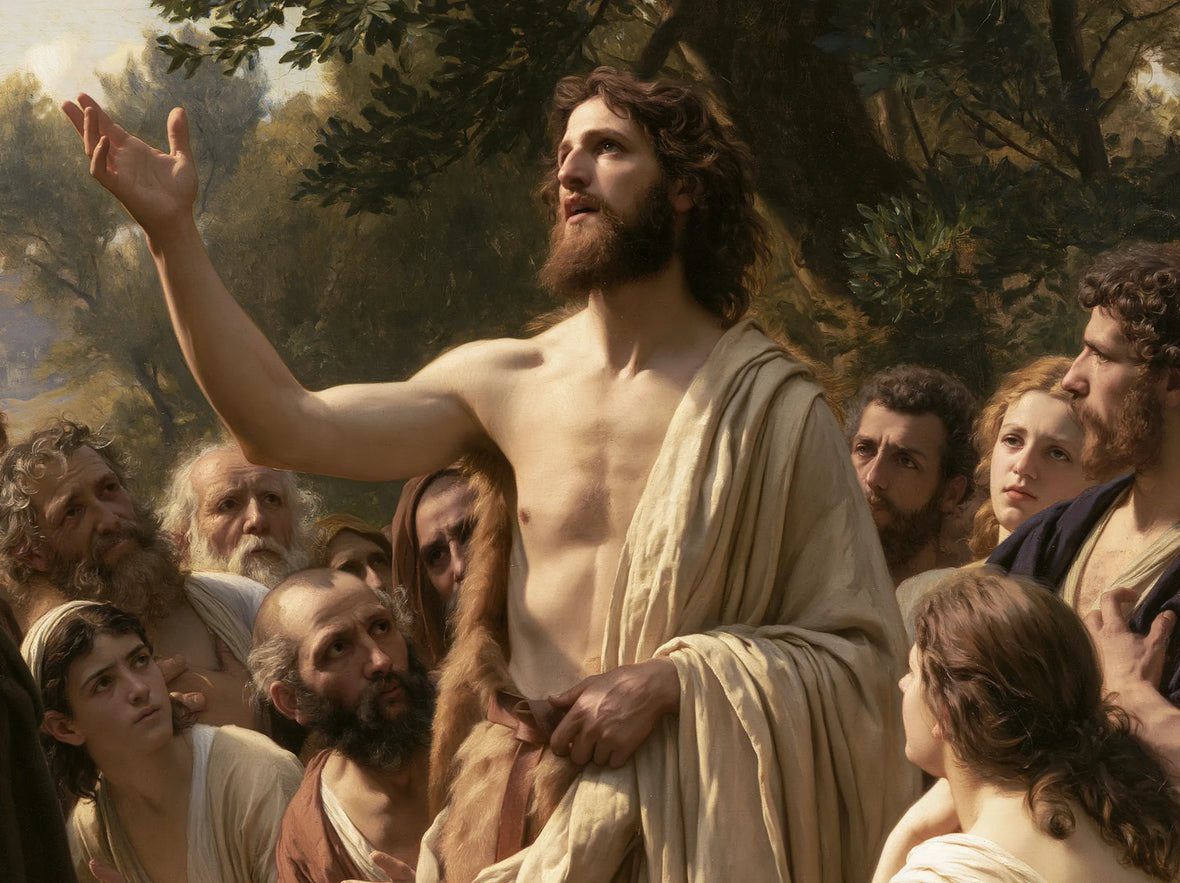
The seated crowd gives the scene the pace of sustained listening. Notice the space between the listeners and the speaker. That interval can distinguish a public address from a private conversation even at a small print size.
3. The Call beneath the Desert Light

Desert light helps the eye read the figures and the ground as one scene. Compare the way it falls on John with its effect on the people hearing him. A wider print gives the setting enough room to participate in the story.
4. The Messenger among the Trees

Trees partly enclose the gathering. Follow the vertical forms until they lead back to the figures. In this setting, wilderness can feel like a place people have entered together.
5. The Listening Assembly

Begin with the listeners instead of the speaker. Their posture can suggest surprise, reluctance or attention. This version gives the crowd a role in the narrative Luke describes when people ask John what they should do.
6. The Prophet in Profile
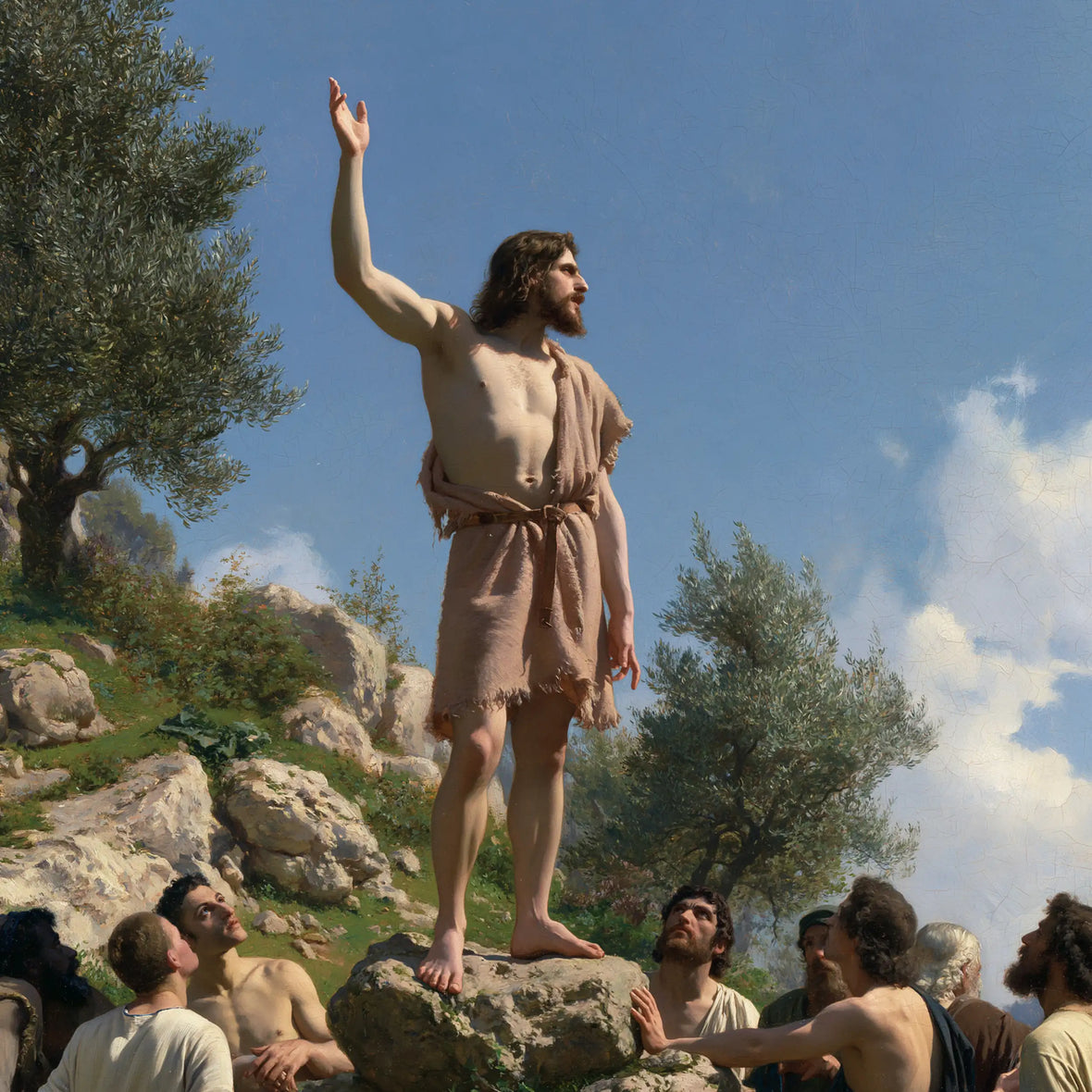
A profile makes the direction of the words clear. Follow the line of John’s gaze before looking around him. A compact print can preserve the gesture while a larger one gives the viewer more access to the surrounding detail.
7. A Voice beneath the Olive Tree

The olive tree gives the eye a point of rest above the gathering. Compare its shape with the position of John. This relationship between a single figure and a tree can stay readable across a room.
8. The Prophet at the Centre

A central preacher gives the eye a stable place to begin. Look again at how the surrounding people are distributed. Their distance from John can suggest how a gathering takes shape in an open place.
9. The Rocky Slope Sermon

A rocky slope provides its own seating and levels. Notice how the ground links people at different heights. The full composition is useful when the terrain determines where the listener can stand or sit.
10. The Kingdom Is Near

The title recalls Matthew’s account of the kingdom drawing near. Ask how the artist makes an announcement visible through a particular moment of gathering. Compare the relation of John to the crowd with the quiet seated version.
What is John asking his listeners to do?
Matthew presents John as preparing the way for the Lord. In Luke 3:7–18, the listeners ask what they should do, and John answers with practical examples of sharing and fair dealing. That exchange gives the crowd a role in the story and offers another way to look at the faces surrounding him.
Choosing a print of John preaching
Choose a version with a strong silhouette if the work will be seen from across a room. For a print that rewards close attention, look for the differences among the listeners. A wide landscape version preserves the terrain that makes this gathering possible.